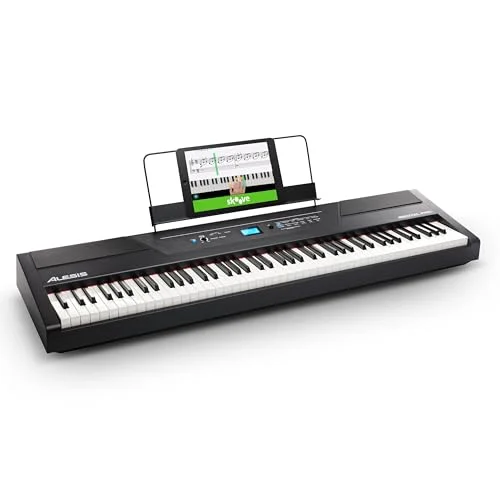
Alesis Recital Pro: full specification | Keys | 88, hammer-action weighted |
|---|
| Key action | Full-size hammer action, adjustable touch |
|---|
| Sound engine | Premium voices, 128-note polyphony |
|---|
| Speakers | 2 x 10 W (20 W total) |
|---|
| Voices | 12 |
|---|
| Bluetooth | No (USB-MIDI only) |
|---|
| Weight | 7.5 kg |
|---|
| Price | £279 |
|---|
| Display | 1-line backlit LCD |
|---|
| Lesson mode | Yes, split keyboard for teacher and pupil |
|---|
Who is the Alesis Recital Pro for?
The Recital Pro is for the complete beginner, or the parent of one, who wants to spend as little as possible while still getting a real weighted action. At £279 it costs less than the stand for some pianos, yet it gives you all 88 keys with hammer weighting, an LCD screen and a lesson mode that splits the keyboard so a teacher and pupil can play the same notes side by side. It is the lightest unit here at 7.5 kg, so a child can move it. It is not the right choice for a committed player who will progress quickly: the action is lighter and less even than a Yamaha P-145 or Casio PX-S1100, and such a player will outgrow it within a year or two.
Best for: the budget-first beginner who wants real 88 weighted keys for the least money, and is happy to upgrade later if they stick with it.
How the Alesis Recital Pro performs
The key action
The Recital Pro has a full-size 88-note hammer action with three adjustable touch-response settings, and that it exists at all at this price is the headline. The keys do push back like a piano rather than a synth, which is the whole point and the thing cheaper 61-key keyboards cannot offer. Be realistic, though: side by side with the £419 Yamaha, the action is lighter, a little springier and slightly less even from note to note. It builds the right basic habits for a beginner, but a grade-three or grade-four player will feel its limits. Within its budget brief, it does the essential job.
The sound
You get 12 voices, including a decent acoustic grand, plus electric pianos, organ and strings, and 128-note polyphony, which is genuinely generous at this price and more than the 64 notes of the far pricier Yamaha P-145. In practice that means the sustain pedal will not cut notes off during normal beginner repertoire. The grand voice is pleasant rather than rich, clearly a step behind the sampled grands of the £600 pianos, but perfectly good for learning scales, hymns and early pieces.
The speakers
The twin 10 W drivers give 20 W in total, which is genuinely loud for the money and beats both the 16 W Casio and the 14 W Yamaha on paper. They fill a bedroom or a small living room easily. The tone is less refined than the pricier units, with a little less warmth at volume, but for a beginner practising at home the output is more than enough, and there is a 6.3 mm headphone socket for silent practice.
Features and build
For £279 the feature list is surprisingly full: a one-line backlit LCD, the split lesson mode, record and a metronome, plus a USB-MIDI port to connect a computer or tablet for learning apps. The build is where the savings show, with a more plasticky cabinet than the heavier units, and there is no Bluetooth, so app connection needs a cable. Setup is quick, and a basic sustain pedal is included in the box, which keeps the total starting cost low.
The honest downsides
The Recital Pro's compromises are exactly what you would expect at the price. The action is the main one: it is real and weighted, but lighter and less even than the £400-plus pianos, so a fast-improving player will want to upgrade. The cabinet feels budget, there is no Bluetooth, and the sampled grand lacks the depth of a Roland or Kawai. We would never recommend it to a serious player, but as the cheapest way to begin on proper weighted keys it earns its budget crown.