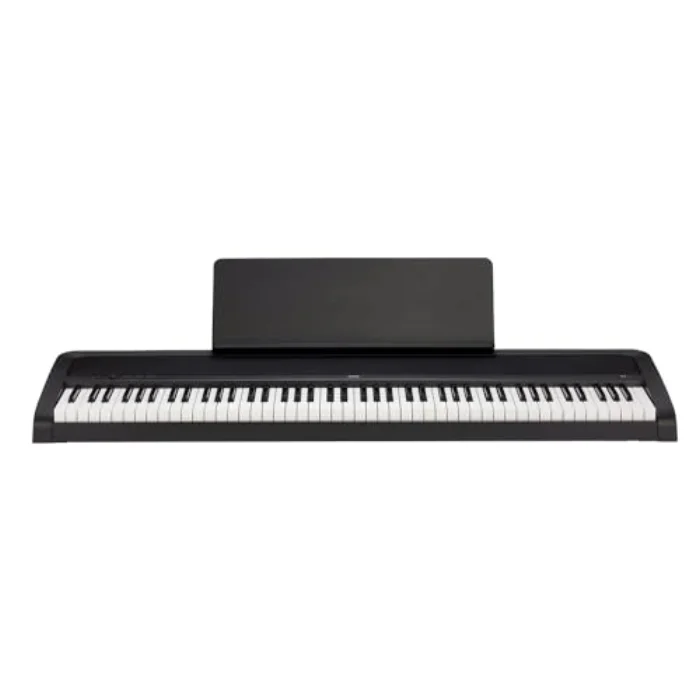
Korg B2: full specification | Keys | 88, fully weighted |
|---|
| Key action | Natural Weighted Hammer Action (NH) |
|---|
| Sound engine | Stereo PCM, 120-note polyphony |
|---|
| Speakers | 2 x 15 W (30 W total) |
|---|
| Voices | 12 |
|---|
| Bluetooth | No (USB-MIDI + audio) |
|---|
| Weight | 11.4 kg |
|---|
| Price | £379 |
|---|
| USB audio | Yes, record direct to computer |
|---|
| Cabinet depth | 33.6 cm |
|---|
Who is the Korg B2 for?
The B2 suits the player who wants the most room-filling sound for under £400, and who values strong speakers and clean recording over a long voice list or wireless features. With 30 W of speaker power it comfortably outguns the 16 W Casio and the 14 W Yamaha in this comparison, despite costing less, and the USB audio output makes it a sensible budget choice for a home studio or content creator who wants to record without an extra interface. It is less suited to someone who wants the finest action, where the Yamaha and the pricier Kawai pull ahead, or the slimmest cabinet, where the Casio wins.
Best for: the home player who wants the biggest, fullest sound for the money and a simple way to record.
How the Korg B2 performs
The key action
The Natural Weighted Hammer action gives the B2 a genuine 88-note weighted bed that is even and predictable across the keyboard. Through scales and a Schumann piece it stayed consistent, and it is a real, technique-building action rather than a semi-weighted compromise. Side by side with the Yamaha P-145, though, it feels a touch springier and less graded, returning to rest a little more eagerly. It is a perfectly good action for the price, comfortably better than the budget Alesis, just not quite as refined as the £400-plus Yamaha or the £600-plus pianos.
The sound
Korg's stereo PCM engine drives a grand voice sampled from a concert grand, and it is warm and pleasant if a step behind the modelled, multi-sampled grands of the Roland and Kawai. The 120-note polyphony is generous and easily handles pedalled, sustained passages without dropping notes. The voice list is short at 12, covering the essentials, two grand voices, electric pianos, organs and harpsichord, but the strength here was always going to be how that sound is projected rather than the breadth of the menu.
The speakers
This is the B2's whole reason for being. The twin 15 W drivers give 30 W in total, the second most powerful system in our comparison behind only the £729 Kawai, and remarkable in a piano costing £379. In a living room of 20 m² or more it fills the space with body and warmth that the cheaper Yamaha and slim Casio simply cannot match, and it never sounds strained. If you want the fullest unamplified sound for the least money, the B2 is the one to hear.
Connectivity and build
The B2 has both USB-MIDI and, unusually at this price, a USB audio output, so you can record a clean stereo signal straight into a computer without an audio interface, which is genuinely useful for a budding producer or YouTuber. There is no Bluetooth, so app connection needs a cable. The cabinet is the deepest here at 33.6 cm and weighs 11.4 kg, solidly built if a little less polished than the Yamaha, and it sets up quickly with the included sustain pedal.
The honest downsides
The B2's compromises are the price you pay for those speakers. The action, while genuinely weighted, is a fraction springier and less graded than the Yamaha's, so feel-focused players will prefer the latter. The voice list is short at 12, there is no Bluetooth, and the deeper 33.6 cm cabinet takes more space than the slim Casio. None of these undoes its core appeal, but they are why it is our best-speakers pick rather than our overall winner.