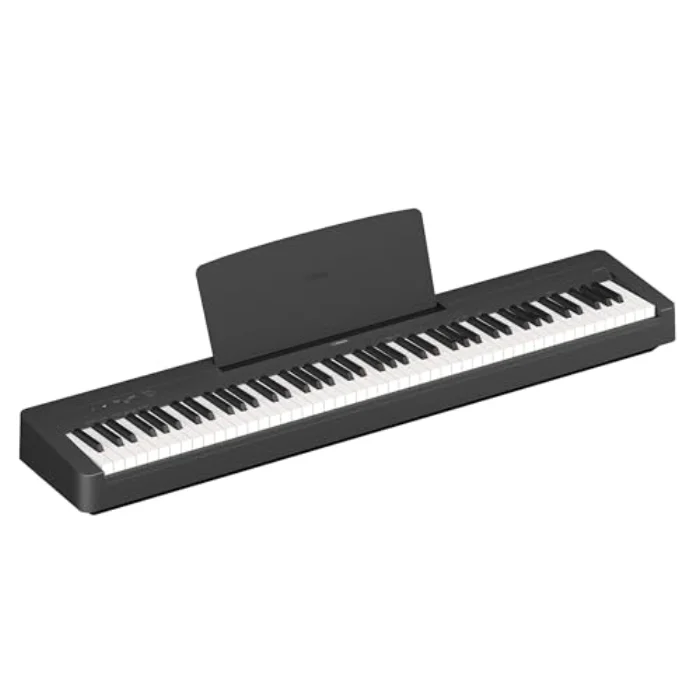
Yamaha P-145: full specification | Keys | 88, fully weighted |
|---|
| Key action | Graded Hammer Compact (GHC) |
|---|
| Sound engine | CFX grand sample, 64-note polyphony |
|---|
| Speakers | 2 x 7 W (14 W total) |
|---|
| Voices | 10 |
|---|
| Bluetooth | No (USB to host) |
|---|
| Weight | 11.5 kg |
|---|
| Price | £419 |
|---|
| Learning app | Smart Pianist (free) |
|---|
| Cabinet depth | 11.6 cm (lid closed) |
|---|
Who is the Yamaha P-145 for?
The P-145 is built for the complete beginner, or the parent buying a child's first proper instrument. The controls are pared right back to a single function button, so there is nothing to fiddle with and nothing to get wrong, and the graded hammer action and CFX grand voice come from a name teachers trust without question. At 11.5 kg it is light enough to move and store. It is not aimed at the gigging player or the fast-progressing student: the 64-note polyphony and 14 W speakers are the most modest in our comparison, and an improving player will soon want the headroom of the Roland FP-30X or the value of the Casio PX-S1100.
Best for: the first-time learner who wants a simple, trustworthy piano with a great grand voice and no clutter.
How the Yamaha P-145 performs
The key action
The Graded Hammer Compact action is firm, even and reassuringly solid under the fingers. It is graded, so the bass keys press heavier than the treble, and across scales and a Bach minuet it stayed consistent with no rattle. It is a slightly shorter action than a full-size bed, the compromise that keeps the cabinet light and affordable, so the most advanced players will feel it is not as deep as the Kawai or Roland. For a beginner building technique, though, it teaches all the right habits and is a clear cut above any semi-weighted keyboard.
The sound
This is where the P-145 punches above its price. The headline grand voice is sampled from the Yamaha CFX, the same concert grand used on the world's stages, and it sounds far classier than £419 has any right to, clear and bright with real presence. There are 10 voices in total, which is the fewest here but covers the essentials: a second grand, electric pianos, organs and harpsichord. The catch is the polyphony: at 64 notes it is the lowest in our six, half the 128 of the cheaper Alesis, so on dense, heavily pedalled passages with layered voices you can occasionally hear older notes drop away. For beginner repertoire you will rarely notice; for complex pieces it is the spec that gives the P-145 away as an entry-level model.
The speakers
The twin 7 W drivers give 14 W in total, the lowest figure in our comparison. In a bedroom or a study they are perfectly clear and pleasant, but in a larger room they run out of headroom sooner than the 22 W Roland or 40 W Kawai. For a beginner practising at home this is rarely an issue, and the headphone socket makes silent practice easy, but it is another reason we frame this as a learner's piano rather than a performer's.
Features and build
Yamaha keeps it simple by design. There is no Bluetooth; instead the piano connects to the free Smart Pianist app over a USB-to-host cable, which turns a phone or tablet into a clear control screen and adds guided lessons and song scores. The cabinet is light and tidy at 11.5 kg, the matte finish is smart, and a basic sustain pedal is included. Setup is genuinely a two-minute job, which matters for the buyers this piano is aimed at.
The honest downsides
The P-145's compromises all stem from its entry-level brief. The 64-note polyphony is the standout: it is the lowest here and will limit you on complex, pedalled music as you improve. The 14 W speakers are the quietest in the group, there is no Bluetooth, and the voice list is short at 10. None of this matters much for a beginner, but it does mean a fast-progressing player will outgrow the P-145 sooner than the £600 pianos, which is exactly why we treat it as the best first piano rather than the best overall.