Casio PX-S1100 review: the best value digital piano

The Casio PX-S1100 packs a genuinely weighted 88-key action and a lovely grand voice into the slimmest, lightest cabinet in our comparison: 23 cm deep and 11.2 kg, with battery power on tap. At £599 it is our best value pick, and the obvious choice for anyone short on space.

Transparency: This article contains affiliate links. If you buy through one of them, we may earn a commission, at no extra cost to you. That is how we fund our testing and keep this site independent. More about how we test.

Contents

Casio's Privia line has quietly become the default recommendation for players who want a real piano feel without a real piano footprint, and the PX-S1100 is the model that does it best. It looks almost impossibly slim, runs on AA batteries if you want it to, and yet plays like a far bigger instrument. We spent a good seven hours with it across a fortnight, and the longer we lived with it the more sense it made as the value pick of this group.

Specifications

Model Price KeysKey actionSound engine Rating Link
Casio PX-S1100 Privia Digital Piano ★ Top pick Casio PX-S1100 Privia Digital Piano £1,062.00 88, fully weightedSmart Scaled Hammer ActionMorphing AiR, 192-note polyphony ★ 4.5 View →
★ Top pick
Casio PX-S1100 Privia Digital Piano £1,062.00
Keys : 88, fully weightedKey action : Smart Scaled Hammer ActionSound engine : Morphing AiR, 192-note polyphony ★ 4.5/5
View on Amazon →

Our in-depth review

BEST VALUE
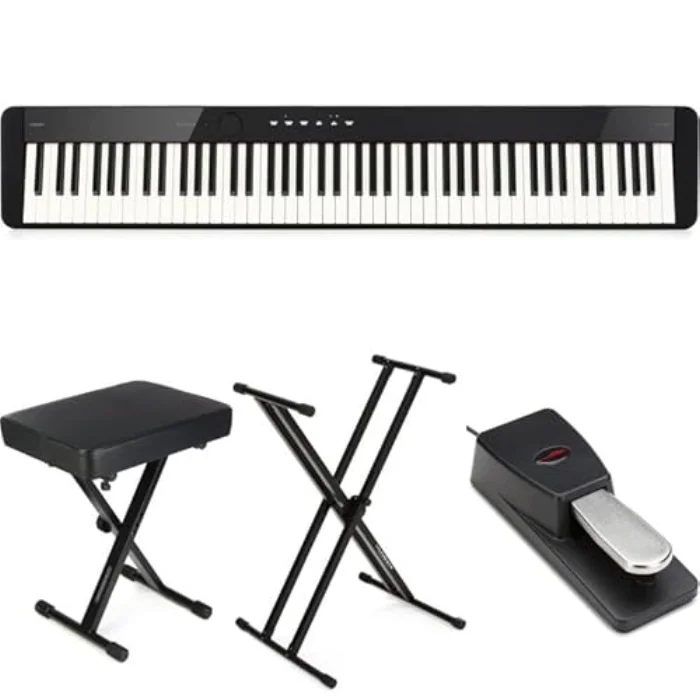
Casio PX-S1100 Privia Digital Piano - digital piano Casio

Casio PX-S1100 Privia Digital Piano

4.5/5

£1,062.00

88, fully weighted · Smart Scaled Hammer Action · Morphing AiR, 192-note polyphony

  • Slimmest cabinet here at just 23 cm deep
  • Lightest full-weight piano on test at 11.2 kg
  • Can run on 6 AA batteries for buskers
  • Excellent grand-piano voice for the money
  • 16 W speakers are quieter than the Roland
  • Touch controls take getting used to
Key action 4/5
Sound 4/5
Build 4/5
View on Amazon →

The verdict from Anaya Iyer, pianist and keyboard reviewer

Our best value choice. The Casio PX-S1100 packs a convincing weighted action and a lovely main grand voice into the slimmest, lightest cabinet in this comparison: 23 cm deep and 11.2 kg. The 16 W speakers do not throw as much sound as the Roland, but for a flat, a bedroom or a portable rig the PX-S1100 is hard to beat. The optional battery power and Bluetooth audio make it the obvious pick for anyone short on space.

Feels remarkably light to carry yet the keys still push back with proper hammer weight.

Casio PX-S1100: full specification
Keys88, fully weighted
Key actionSmart Scaled Hammer Action
Sound engineMorphing AiR, 192-note polyphony
Speakers2 x 8 W (16 W total)
Voices18
BluetoothAudio (via adaptor)
Weight11.2 kg
Price£599
Cabinet depth23.2 cm
Battery option6 x AA, around 4 hours

Who is the Casio PX-S1100 for?

The PX-S1100 is built for the player who is short on space or who needs to move the piano around. At just 23.2 cm deep it sits against a wall or on a narrow desk where a bulkier piano would not fit, and at 11.2 kg it is the lightest fully weighted unit here by a clear margin, beating even the 11.4 kg Korg B2 and the 11.5 kg Yamaha P-145. Add the 6-AA battery option and it becomes a true take-anywhere instrument for a busker, a peripatetic teacher or a student in a small flat. It is less ideal for someone who wants the biggest sound in a large room, where the 22 W Roland or 40 W Kawai pull ahead.

Best for: the space-conscious player who wants real weighted keys, portability and battery power, and the best overall instrument for the money.

How the Casio PX-S1100 performs

The key action

Casio's Smart Scaled Hammer Action is the engineering trick that lets the cabinet be so slim, and it works far better than its compact size suggests. It is a genuinely weighted hammer bed, graded so the bass keys press heavier than the treble, with simulated ebony and ivory key tops that grip well over a long session. Across scales and a Debussy prelude it stayed even, and the only tell that you are not on a full-depth action is a slightly shorter pivot length, which experienced players may notice but beginners will not. It is a touch behind the Roland and Kawai for outright depth, but ahead of anything else at the price.

The sound

The Multi-dimensional Morphing AiR engine drives a grand voice that is one of the highlights of the test. Casio sampled a full concert grand at multiple dynamic levels, and the result is a tone that opens up as you dig in and softens as you ease off, with damper resonance that adds body when you hold the pedal. The 192-note polyphony is generous, enough to sustain dense, pedalled passages without dropping notes, and the 18-voice list covers electric pianos, strings and organs that are all usable rather than novelties.

The speakers

The twin 8 W drivers give 16 W total. That is the second-lowest figure in our six, ahead only of the 14 W Yamaha, and it tells you exactly where this piano belongs: in a bedroom, a study or a flat rather than a large open-plan living room. In a 12 to 16 m² room it sounds full and clear; push it in a bigger space and you will want the line output to powered speakers, or simply slip on headphones, which it does superbly through its 3.5 mm socket.

Portability and build

This is the PX-S1100's party piece. It is 23.2 cm deep, 11.2 kg, and runs on six AA batteries for around four hours, so you can genuinely pick it up and play in the garden or take it to a rehearsal with no mains lead. The cabinet feels solid for its weight, the touch-sensitive control panel keeps the surface clean, and Bluetooth audio (via the optional adaptor) lets you stream music through the speakers. The flush touch controls take a session or two to learn, which is our one mild gripe.

The honest downsides

Two things hold the Casio just behind the Roland. The 16 W speakers are noticeably quieter, so in a big room it needs help, and the flat, touch-sensitive control buttons are less intuitive than physical ones, especially in low light. The compact action, while excellent, is also a fraction shallower than a full-size bed, which the most advanced players might feel. None of these is a deal-breaker, and for most buyers the slim cabinet and battery power more than make up for them.
Frequently asked questions

Q
Is the Casio PX-S1100 fully weighted?

Yes. It uses Casio's Smart Scaled Hammer Action across all 88 keys, with simulated ebony and ivory key tops for grip. It is genuinely weighted, not semi-weighted, so it builds proper technique, all in a cabinet just 23 cm deep.

Q
Can the Casio PX-S1100 run on batteries?

Yes. It runs on 6 AA batteries as well as mains power, which together with its 11.2 kg weight makes it the most portable piano in our comparison. That makes it a strong choice for buskers, teachers who travel, and anyone short on a permanent space.

Q
How loud is the Casio PX-S1100?

Its twin 8 W speakers give 16 W total, which is ample for a bedroom or a flat but quieter than the Roland's 22 W or the Kawai's 40 W. For a larger living room you may want to add headphones or external speakers via the line out.

Q
Casio PX-S1100 or Yamaha P-145?

Choose the Casio for its slimmer cabinet, battery power and richer 18-voice set; choose the Yamaha P-145 if you want the cheapest route to a trusted CFX grand voice for pure beginner practice. The Casio is the more versatile instrument and the better long-term buy.

Verdict on the Casio PX-S1100

The Casio PX-S1100 is our best value pick because it delivers a convincing weighted action and a genuinely lovely grand voice in the smallest, lightest, most flexible package here, all for £599. If your room is tight, or you need to move the piano, nothing else comes close. The only reasons to spend more are the louder speakers and slightly deeper action of the Roland FP-30X, our overall winner, or the class-leading feel of the Kawai ES120. For a complete beginner on a tighter budget, the Yamaha P-145 is the cheaper starting point. See our scoring method on the how we test page.