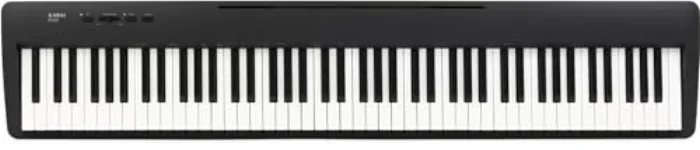
Kawai ES120: full specification | Keys | 88, fully weighted |
|---|
| Key action | Responsive Hammer Compact (RHC) |
|---|
| Sound engine | Harmonic Imaging, 192-note polyphony |
|---|
| Speakers | 2 x 20 W (40 W total) |
|---|
| Voices | 25 |
|---|
| Bluetooth | MIDI |
|---|
| Weight | 12.0 kg |
|---|
| Price | £729 |
|---|
| Cabinet depth | 28.6 cm |
|---|
| Sampled instrument | Shigeru Kawai SK-EX concert grand |
|---|
Who is the Kawai ES120 for?
The ES120 is aimed squarely at the player who cares most about touch and tone: the returning pianist who once played an acoustic, the grade-five-and-above student, or the serious hobbyist who wants the closest thing to a real piano without one in the room. The 40 W speaker system, the most powerful here, also makes it the best choice if the piano doubles as the main music source in a large living room of 25 m² or more. It is not the obvious pick for a rock-bottom budget or for maximum portability, where the £279 Alesis and the 11.2 kg Casio win, but for feel it is unmatched in this group.
Best for: the serious or returning player who will judge the piano on the action first, and wants room-filling sound to match.
How the Kawai ES120 performs
The key action
The Responsive Hammer Compact action is why this piano sits where it does. It is a graded hammer bed, heavier in the bass and lighter in the treble, and across scales, arpeggios and a Brahms intermezzo it gave the most consistent, controllable response of any piano on test. The keys move with a settled, slightly weightier feel than the Roland's PHA-4, closer to a real upright, which rewards careful dynamics and makes soft, quiet playing easier to control. If you have played an acoustic piano, this is the action that will feel most like coming home.
The sound
Kawai's Harmonic Imaging sound engine is built from samples of the Shigeru Kawai SK-EX concert grand, the company's flagship instrument, and it shows. The grand voice is rich and resonant, with string resonance and damper effects that add depth when you hold the pedal, and it ties with the Roland for the most convincing tone here. The 192-note polyphony is ample for dense, pedalled repertoire, and the 25-voice list is shorter than the Roland's 56 but every voice is genuinely usable, from the electric pianos to the warm string pads.
The speakers
The twin 20 W drivers give 40 W in total, the most powerful system in our comparison by a wide margin, nearly double the Roland's 22 W and almost three times the Yamaha's 14 W. In a large living room it fills the space with body and warmth and never sounds strained, even at high volume. This is the one piano here you can comfortably treat as the main sound system for a music room, and it makes the ES120 feel like a more substantial instrument than its compact cabinet suggests.
Connectivity and build
The ES120 has Bluetooth MIDI for connecting Kawai's PianoRemote app and notation software wirelessly, though not Bluetooth audio, so you cannot stream music through the speakers as you can on the Roland. The cabinet is 28.6 cm deep and 12.0 kg, sturdily built with the reassuring feel of a maker that knows pianos, and it sets up in minutes. There is a single 6.3 mm headphone socket on the rear for silent practice.
The honest downsides
The ES120's drawbacks are price and a couple of small omissions. At £729 it is the most expensive piano here, around £80 more than the Roland and £130 more than the Casio, so you are paying a premium for the action and the speakers. It also lacks Bluetooth audio, offers fewer voices than the Roland, and has only one headphone socket. For a player chasing features or value, those count against it; for a player chasing feel, they barely register.